P5 Math
Why My School Exams Might Feel Difficult
The “P6 Concept Pull-down Explained”
If you are a parent of a Primary 5 student, especially in more academically-rigorous schools, you are likely feeling a sense of unease.
The whispers in parent groups are right: you are not imagining the difficulty. The recent Primary 5 Math examination papers have undergone a subtle but significant transformation, making them feel less forgiving and much more challenging than in previous years.
This shift isn't about schools being unnecessarily tough; it's a response to the recent MOE syllabus restructuring. And for parents focused on excellence, this change creates a new, critical time-sensitive gap.
Core Factual Shift: Why Exams Got Tougher
To understand why papers feel harder, we must look at what was removed:
-
Major P5 Topics Shifted To P6: Large, fundamental P5 topics like Ratio and Average have been moved to the P6 syllabus, tightening the runway for P6 students.
-
P5 Testing Gap Created: This shift, alongside the complete removal of Speed from the Primary syllabus (which had to be compensated for elsewhere in the P6 curriculum), created a significant testing vacuum in P5.
This is a dilemma for schools committed to maintaining academic rigour — a critical component for top-school differentiation. A paper with fewer major topics risks being too repetitive or too easy.
The solution, particularly embraced by many top schools, was to implement the P6 Concept Pull-Down: introducing advanced concepts and demanding a higher level of maturity in problem-solving that was traditionally reserved for Primary 6.
What is P6 Concepts Pull-Down?


As exam performance data is analyzed across the region, we are observing that certain high-achieving schools, particularly in the East, are incorporating a significantly higher concentration of these stretch questions (i.e. School TN and KH has 17-22marks allocated for this).
And when these questions are concentrated within Paper 2 - It simultaneously tests the student's resilience, stamina, and strategic, exam-smart thinking under pressure.
Although challenging, these demanding papers should be viewed as an early opportunity for PSLE preparation can become a powerful catalyst, driving students to secure the mastery needed for success next year.
So... What Does It Mean?
The tightening margin of error is the result.
Simple mistakes or a lack of DEEP mastery now lead to demoralizing drops in grades. If not managed well, this can result in students "over-tested" on material they haven't formally covered or have the level of maturity required to solve them.
💡 The Tamago Test of Skill: Why Fundamentals Now Require Mastery
We suspect that the syllabus shift and subsequent P6 Concept Pull-Down are here to stay.
PSLE is one of the single largest human capital allocation exercises in Singapore. With Parliamentary debate actively defending the 15-30 marks Higher Order Thinking questions as key differentiator in Exams. (Subjective as to what might be considered as “Higher-Order”)
This high level of rigour is mandated from the top. The need for differentiation in Singapore’s core examinations is clear, with official debates actively defending the inclusion of Higher Order Thinking (HOT) questions—often accounting for 15-30 marks—as the key differentiator..

Our Pro-active Stance:
Preparing for Tomorrow's Demands, Today
The challenge is real, but it is not a surprise.
At Formative Minds, our role is to act as your shield and guide through these unpredictable shifts. We have been anticipating this syllabus gap since last year, taking proactive measures to ensure our students are not just keeping up, but leading.
What Can You Leverage On?
1. File and Revise Our Tutorials
Since the launch of the new Primary School curriculum, we have actively brought down several P6 topics in advanced into our P5 curriculum. Our curriculum is rigorous and it helps to prepare Students for the tighter margin of error expected of by Schools.
Some of the advanced topic that were brought down were (i) Advance Comparing Difference Concept; (ii) Replacement Concept; (iii) Fractions All Item Changed Concept; (iv) Advanced Percentage Change; (v) Complex multiple rates concepts; etc
We set timers in class for Students to attempt questions before going through whenever time allows instead of just blindly copying.
There are a minimum of 2 sets per non-intensive Revision Week - have a system to file them neatly, you will need them later.

2. Re-attempt Weekly Milestone Quiz Corrections Consistently
Every week, your child completes a 15-minute Milestone Check Quiz. This isn't just a weekly recap; it's a strategically designed assessment using spaced repetition to ensure knowledge retention over time, covering content taught this week, last week, and the week before.
Crucially, every concept is tested across three weeks. If a question is missed, your child has two immediate follow-up opportunities to demonstrate mastery. This structured system prevents 'last-minute' cramming.
The new syllabus shifts unfortunately reduces the margin of error for students and expect them to ramp up a lot faster than before. In order to do so without feeling overwhelmed - the best way is to stay consistent and use the weekly Milestone Exams to revise in bite-sizes.
We strongly encourage you to review their weekly corrections (only 5–6 questions) to enforce accountability. These quizzes feature mixed-topic questions designed to sharpen exam-smart 'gear-changing' skills—forcing your child to correctly identify and apply the right strategy quickly, a critical skill for Paper 2 success.

3. Review Your Child's Data Analytics Periodically
We believe in radical Data Transparency. We won't sugarcoat performance; that robs your child of the crucial chance to improve. Our role is to provide objective, data-centric feedback, empowering you to make the best decision about where to invest their time.
Similar to how we encourage you to use data - we use it to improve ourselves as well!
If most Students in a class performs poorly for a heuristic - it suggest teaching delivery issue.
If multiple same level class performs poorly for a heuristic - it suggest curriculum / content issue.
This oversight allows you to deploy a targeted, "SWAT team" intervention whenever your busy schedule permits, focusing precisely on confirmed weaknesses.
You don't need to be involved every day; you just need to be involved effectively.
This partnership ensures your child remains accountable to their progress, giving you the peace of mind that you are managing their academic journey with maximum efficiency.
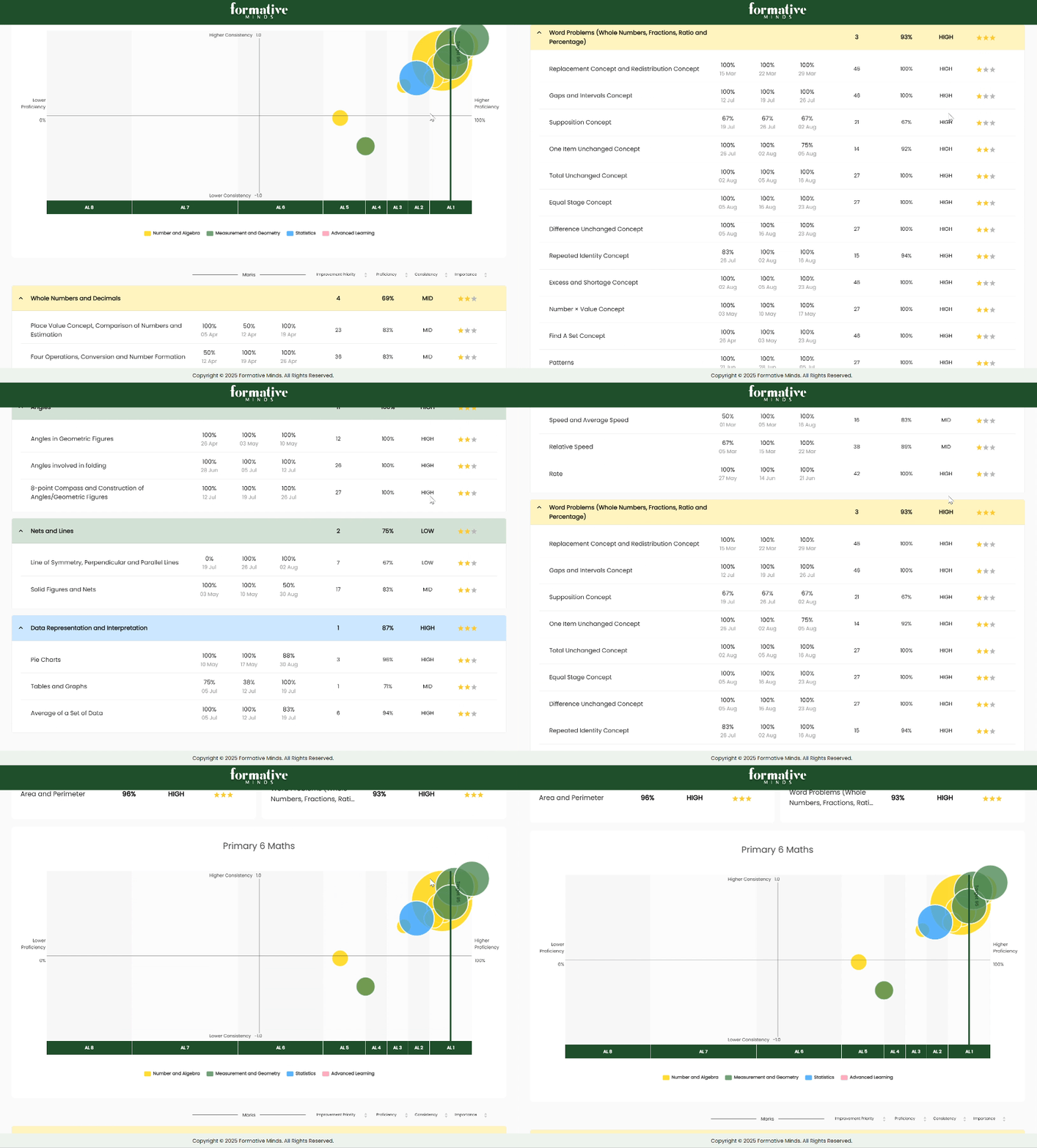
4. Act on our data-backed feedback
Our commitment is to strategic improvement. Periodically, we analyze your child's data to give you optimal, effective revision strategies. This advice is always a powerful blend of hard data and the Teachers' qualitative insight into your child's in-class challenges, ensuring a clear path forward.
We are here for you. If you need an update beyond the regular feedback, please feel free to reach out. We are happy to organize a quick, ad-hoc 15-minute call to walk you through their progress and address any immediate concerns.

5. Review Hyper Targeted Video Links
Complementing our data-driven feedback, we provide a series of hyper-targeted video revision links that focus exclusively on your child's specific weaknesses.
To ensure mastery, these videos are NOT for passive viewing. We strongly coach students to pause the video, attempt the question first, and then watch the solution—this active engagement is the only proven way to translate revision into exam success.


6. Exclusive Exposure: Curated Exams Insights
Beyond our core curriculum and hyper-targeted revision links, our teachers dedicate time to continuously canvass and curate interesting questions from a wide range of past school papers.
This effort is transformed into exclusive online lesson materials, where we guide students through solutions and simultaneously recap fundamental concepts.
This resource is designed to give your child critical exposure to the breadth and diversity of challenging questions outside of our immediate curriculum. We strongly encourage you to ensure your child utilizes these materials, as they are key to developing the adaptability needed for top-tier exam performance.


7. Occasional Cohort Wide Reinforcement
We understand that perfection is the goal, not the starting point. As we review our cohort data weekly, we proactively look for areas where our delivery can be stronger.
Whenever our analysis flags a widespread weakness, suggesting a part of the curriculum isn't fully grasping most students, we immediately take ownership. Teachers actively dedicate time to re-design and re-teach the specific impacted heuristics. This systematic, self-correcting approach significantly improves the chances for every student to achieve true understanding.
We are always looking for ways to improve, ensuring our teaching and materials are continuously optimized for your child's success.


8. Special Programmes
We recognize that the ultimate barrier to success is often not knowledge, but a student’s confidence and discipline. Because every child has unique motivations and areas for growth, our teachers actively identify these needs and invite students to participate in specialized programs for targeted development.
For Example:
-
Circles Programme (Confidence & Momentum): For students needing a boost in confidence, our teachers will take the extra effort to "circle in red" specific questions on their Milestone Quiz that they are expected to conquer. This builds essential momentum and confidence, reframing tougher questions as achievable "stretch goals."
-
Math Challenge (Discipline & Accountability): This program provides a clear structure to build good habits. Students are required to demonstrate discipline by showing evidence that they have re-attempted selected questions from their weekly work and achieved a minimum of 70% on their Weekly Quiz.
-
These, alongside other ad-hoc initiatives (such as our "Careless Joe" program), ensure that our support is not just academic—it's holistic and tailored to your child's success mindset.

9. Small Study Group (~3pax max)
For those "stubborn" heuristics that resist initial revision, students can book additional, ad-hoc classes (subject to availability). These sessions are not meant to be a continuous "double tuition."
Instead, they are designed to be used in targeted short bursts to swiftly unravel specific, difficult weaknesses.
We understand that your child's primary limitation is their lack of time, and this resource provides maximum improvement with minimum time investment.

10. Strategic Enrolment for Holiday Bootcamp
During every holiday period, we run additional Bootcamps that are curated for our regular students.
These are not generic courses. We systematically compile and analyze entire cohort data to precisely identify the most significant weaknesses shared across the student population.
The result is a Bootcamp focused purely on high-impact, cohort-specific mastery.
Strategic Enrollment: Check the Data First
We believe in the efficient use of your child's time. To ensure the Bootcamp is the right fit, we encourage you to reach out to us before enrolling. We will check the concepts covered against your child's own personalized data profile.
If the content does not map directly to your child's primary areas of weakness, we will advise your child to allocate their time elsewhere to pursue other academic or holistic interests.
Your child's optimal growth is our priority, not mandatory enrollment.
Achieving PSLE Success
See How Data Translates Into
Real Progress and Builds Confidence
That Carries Into Adulthood.


In 2025 alone, we helped 8 students be one of the top in their cohort across 7 different schools — with 2 of them achieving a perfect FULL 100/100 marks!
What makes this truly inspiring is that not most of them started strong; many were scoring 50+ just before joining at Formative Minds. These results prove success is not about innate ability—it's about the right system and commitment to growth. Many times in life, the effort we put in may not directly translate into tangible results but we are very happy that it did for our students.
At Formative Minds, we teach more than just Math—we teach how to think, apply, and grow. Our programme focuses heavily on Problem Sums, builds exam discipline through weekly diagnostic tests, and uses data analytics for clear, targeted feedback. This allows every child to focus, improve efficiently, and build habits that last beyond the classroom.
Beyond Scores:
Building Character and Resilience
We know a child's future is not determined by a single score. At Formative Minds, we believe the true measure of success is in the attitude forged during the learning journey.
The exam is simply a number. What truly matters is the process of learning: the resilience to keep going, the speed at which one learns to bounce back from failure, and the discipline built through consistent effort. These are the foundations of character that students carry into adulthood.
By building these basics at the primary level, we are equipping them to adapt to the changing world. The way they resolve challenges in their younger years becomes the blueprint for handling life's biggest obstacles. Problems will always come and go, but the lessons learned and the processes we develop to solve them will remain constant.
Formative Voices
Success Beyond Classroom
To show our students that success in life takes many forms and paths, we launched an initiative called “Formative Voices.”
Through this series, we interview a diverse range of people about their unique education journey and what they are currently achieving in life. It's about demonstrating that education is just the start—a foundation—and a single exam score does not define a destiny.
